


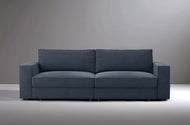


 Aura Convertible Twin Sleeper Chair
 Optic Queen Sleeper Sofa
 Optic Multifunctional Ottoman with Storage
 Gateway Queen Sleeper Sofa
 Tera Queen Sleeper Sofa
 Galaxy Full-Sized Sleeper Loveseat
 Galaxy Queen Sleeper Sofa
 Switch Queen Sleeper Sofa
 Switch Queen Sleeper Sectional with Storage Chaise
 Nova Full-Sized Sleeper Sofa
 Nova Full-Size Sleeper Sectional with Storage Chaise
 Toggle Full-Sized Convertible Couch with 16-Position Configurations
Convertible Sofas vs. Sleeper Sofas
20 Feb 2026
Time to read: 5 min
Share Article:
Introduction
At first glance, convertible sofas and sleeper sofas sound interchangeable. After all, both promise to turn your sofa into a bed.
But the way they function—and how comfortable they actually are—can be very different.
If you’re furnishing a small space, a guest room, or a living room that needs to do double duty, understanding the real difference between a convertible sofa and a sleeper sofa can save you from buyer’s remorse later. Many people researching sleeper sofas start by saving ideas for small spaces, guest rooms, or multipurpose living rooms.
This guide breaks down how each option works, who they’re best for, and what to look for if comfort and everyday usability matter.


Quick Answer: What’s the Difference?
Sleeper sofas typically use a pull-out mattress hidden inside the sofa frame.
Convertible sofas transform the seating surface itself into a sleeping surface—without a separate mattress.
That distinction affects comfort, ease of use, durability, and how often the sofa can realistically be used as a bed.
What Is a Sleeper Sofa?
A sleeper sofa is what most people grew up with: a traditional sofa that hides a fold-out mattress inside the frame.
How Sleeper Sofas Work
- Cushions are removed
- A metal frame unfolds
- A thin mattress rests on support bars or springs
Pros
- Familiar setup
- Clear separation between sofa and mattress
- Works well for occasional guests
Cons
- Bars and uneven support are common
- Heavier mechanisms
- Conversion takes time and effort
- Mattresses are often thinner than standard beds
Across homeowner and apartment-dweller discussions on Reddit, traditional pull-out sleeper sofas are frequently criticized for comfort issues. Many users describe feeling metal support bars through thin mattresses, uneven sleeping surfaces, and poor support—especially for adults or multi-night stays. In several long-running threads, people note that even with mattress toppers, classic sleeper sofas often fall short compared to newer convertible designs that eliminate metal frames entirely.
What Is a Convertible Sofa?
A convertible sofa is designed so the seating surface itself becomes the sleeping surface—no hidden mattress required.
Instead of unfolding a metal frame, the sofa converts through:
- Sliding bases
- Folding backs
- Trundle-style extensions
- Modular reconfiguration
Pros
- Flat, bar-free sleeping surfaces
- Faster, easier conversion
- Better support for frequent sleeping
- Often more space-efficient
Cons
- Less familiar to some shoppers
- Comfort depends heavily on foam quality and construction.


ConvertibleSofa vs. Sleeper Sofa: Side-by-Side Comparison
| Feature | Sleeper Sofa | Convertible Sofa |
|---|---|---|
| Sleeping Surface | Separate mattress on metal frame | Sofa cushions convert into bed |
| Comfort | Can include bars or uneven support | Flat, even surface |
| Ease of Conversion | Multiple steps, heavier lift | Often converts in seconds |
| Best Use | Occasional overnight guests | Frequent sleeping or daily use |
| Space Efficiency | Bulkier mechanisms | More compact designs |
| Long-Term Durability | Mattress wears separately | Foam quality is key |
Which Option Is Better for Everyday Sleeping?
If you plan to use your sofa as a bed more than a few times a year, convertible sofas generally perform better.
Why?
- No metal bars pressing through the mattress
- More consistent support across the entire surface
- Fewer moving parts that loosen over time
This is why many modern furniture brands have shifted toward convertible designs for apartments, studios, and multipurpose living rooms. In online discussions, people who sleep on their sofas weekly often report that convertible designs feel noticeably more supportive over time than traditional pull-out sleepers.
What About Comfort?
Comfort comes down to design, not just category.
A well-designed convertible sofa uses:
- High-density foam
- Reinforced frames
- Even weight distribution
A poorly designed sleeper sofa often relies on:
- Thin mattresses
- Sagging springs
- Support bars
The key question to ask is not “Is it a sleeper?” but “Was this designed to be slept on regularly?”
Which Is Better for Small Spaces?
Convertible sofas almost always win in small spaces.
They:
- Require less clearance to open
- Avoid bulky internal mechanisms
- Often include storage or modular flexibility
Which One Should You Choose?
Choose a Sleeper Sofa if:
- Sleeping is rare
- You want a traditional mattress feel
- The sofa is mainly for guests
Choose a Convertible Sofa if:
- You plan to sleep on it weekly or daily
- You live in a small or multifunctional space
- Ease of use and comfort matter most
Why Coddle Focuses on Convertible Designs
Coddle sleeper sofas are designed using convertible systems rather than traditional pull-out mattresses.
That means:
- Flat, bar-free sleeping surfaces
- Faster, simpler conversion
- Comfort that works for sitting and sleeping
- Smarter use of space for real homes
Instead of designing a sofa first and adding a bed later, Coddle designs seating and sleeping together—so neither feels like an afterthought.
Key Takeaways
- Sleeper sofas use pull-out mattresses; convertible sofas transform the seating surface
- Convertible sofas offer better support for frequent sleeping
- Ease of use and comfort matter more than labels
- Small spaces benefit most from convertible designs
- Design quality determines comfort—not the name alone
Frequently Asked Questions
Are convertible sofas more comfortable than sleeper sofas?
Often, yes—especially for frequent use. Convertible sofas avoid metal bars and uneven mattress support.
Are sleeper sofas outdated?
Not entirely, but many modern homes prefer convertible designs for comfort and ease of use.
Is a convertible sofa good for everyday sleeping?
Yes, when designed with high-density foam and reinforced frames, convertible sofas are well-suited for daily use.
Share Article: